Phrase (Basic ㊦ 200)
Doing something is possible
Equivalent: Can; be able to
| Vinformal nonpast | ことが出来る | |
| 話すことが出来る | Someone can talk | |
| 食べることが出来る | Someone can eat |
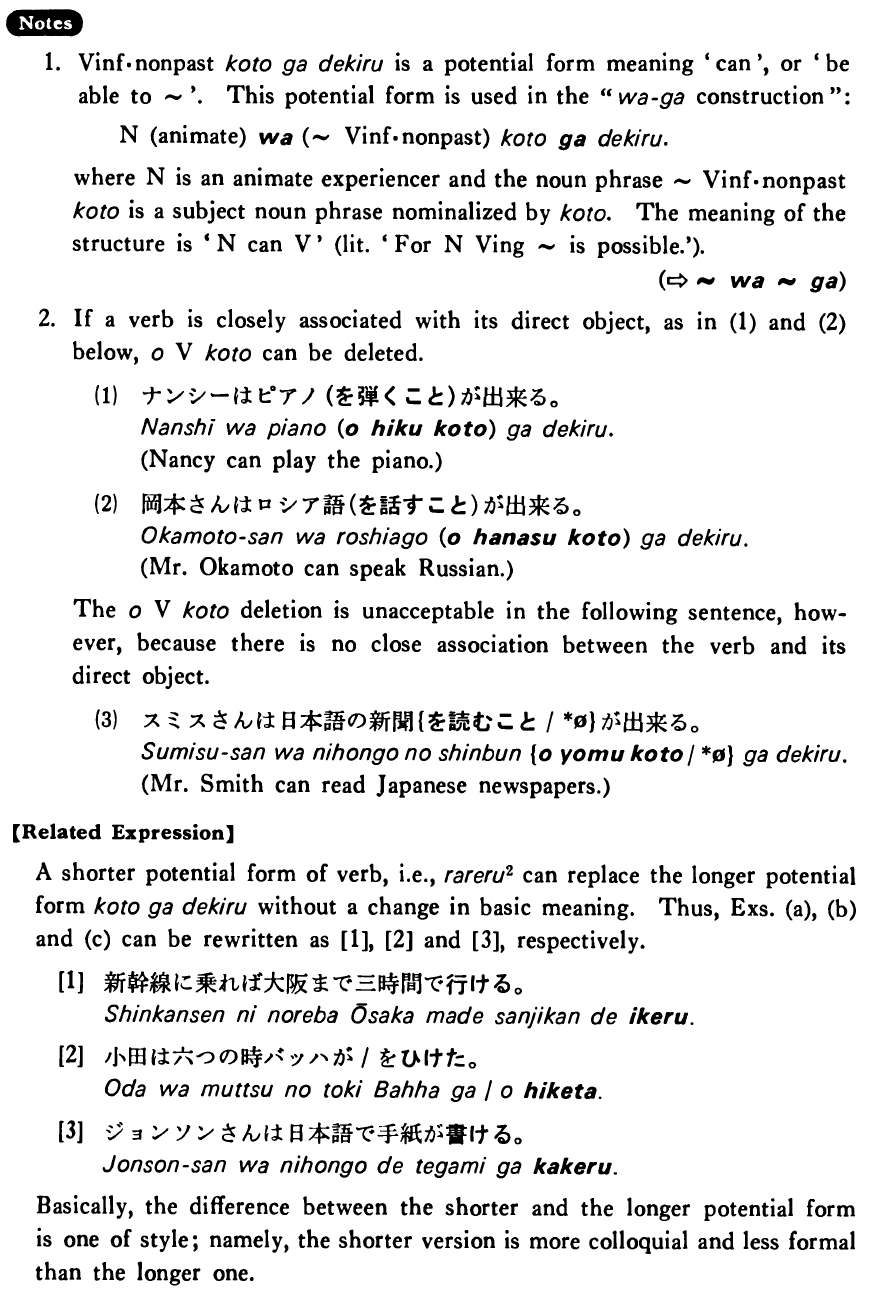
1. Verb informal nonpast ことが出来る is a potential form meaning 'can' or 'be able to ~'. This potential form is used in the "は~が construction":
where Noun is an animate experiencer and the noun phrase ~Verb informal nonpast こと is a subject noun phrase nominalized by こと. The meaning of the structure is 'Noun can Verb' (Literally: 'For Noun, Verbing~ is possible.').
(⇨ は~が)
2. If a verb is closely associated with its direct object, as in (1) and (2) below, をVerbこと can be deleted.
The をVerbこと deletion is unacceptable in the following sentence, however, because there is no close association between the verb and its direct object.
【Related Expression】
A shorter potential form of verb, i.e., られる2 can replace the longer potential form ことが出来る without a change in basic meaning. Thus, Examples (a), (b) and (c) can be rewritten as [1], [2] and [3], respectively.
[1]
[2]
[3]
Basically, the difference between the shorter and the longer potential form is one of style; namely, the shorter version is more colloquial and less formal than the longer one.